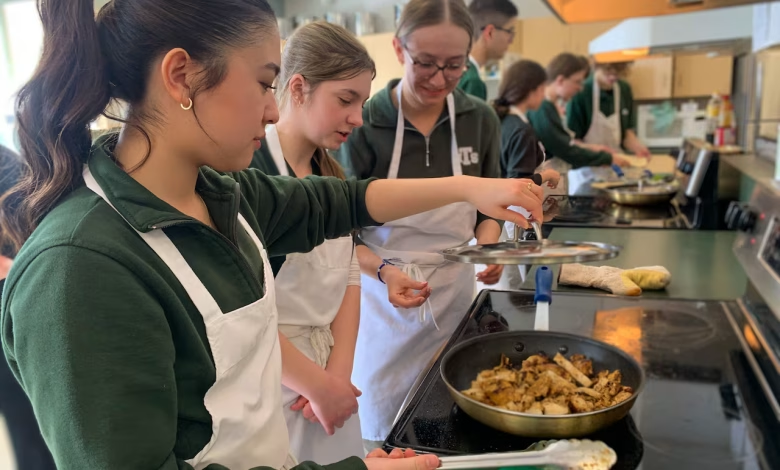
Kitchens are the energetic heart of modern family homes, filled with tempting smells, vibrant colors, and dynamic movement. While many adults view baking merely as a chore or a weekend meal preparation task, the home kitchen is actually one of the most effective and accessible experiential classrooms available. Stepping away from workbooks, digital flashcards, and sterile school desks to measure flour and crack eggs brings abstract academic ideas to vivid, tangible life.
Baking blends multiple learning subjects seamlessly into single afternoon activities without feeling like tedious academic homework. When children measure dry powders, knead yeasted bread, watch butter cream with sugar, or track baking times on an oven timer, they directly apply principles of applied arithmetic, foundational chemistry, physical mechanics, and written literacy. Transforming baking sessions into family learning opportunities creates an encouraging environment where questions are welcomed, trial and error is celebrated, and educational success is rewarded with delicious homemade treats.
Foundations of Kitchen Arithmetic and Practical Chemistry
Baking is fundamentally an exact science governed by delicate chemical balances, which makes it an outstanding tool for teaching children the importance of precision. Unlike loose stovetop cooking, where a pinch of seasoning or an extra splash of broth rarely breaks a dish, baking depends on precise volumetric and mass measurements. Introducing young learners to standard measuring spoons, liquid measuring cups, and digital kitchen scales demystifies fundamental mathematical fractions that often confuse students in traditional classrooms.
Preparing a double batch of simple drop cookies gives children immediate real-world practice with operational arithmetic. When a recipe asks for three-quarters of a cup of flour, parents can challenge children to identify how many quarter-cup scoops are needed to reach that total. Doubling or cutting a recipe in half transforms dry, paper-based fraction problems into essential, practical steps toward a tasty goal. Moving from volumetric cups to a digital kitchen gram scale adds a valuable lesson in metric conversion and teaches children why commercial bakers weigh ingredients for consistent, professional results.
Beyond foundational arithmetic, the oven functions as an accessible chemistry laboratory that demonstrates structural transformation under controlled heat. Making Irish soda bread or classic buttermilk biscuits introduces young minds to acid-base chemical reactions. When acidic buttermilk combines with alkaline baking soda, the two ingredients immediately produce tiny bubbles of carbon dioxide gas. Explain to your children that these trapped gas pockets expand inside the hot oven, forcing the dough upward and producing a light, tender crumb structure rather than a dense, leaden brick.
Yeast baking projects like simple focaccia or homemade pizza crust expand this scientific exploration into the microscopic realm of biology. Handling active dry yeast allows children to witness dormant single-celled organisms awaken through proper hydration and warmth. Watching a yeast mixture bubble after feeding on a small spoonful of sugar introduces foundational biological concepts like metabolism and fermentation. Allowing children to punch down risen dough demonstrates how elastic strands of gluten trap the carbon dioxide produced by the living yeast cells over several hours of proofing.
Motor Skill Development, Spatial Logic, and Reading Fluency
The physical actions involved in home baking offer rich sensory feedback that accelerates the development of fine and gross motor skills in young children. Pouring liquid oil from a measuring pitcher into a glass bowl trains hand-eye coordination, balance, and spatial judgment. Cracking an egg against a flat countertop without pulverizing the protective outer shell demands delicate finger dexterity and muscle control, teaching patience alongside fine physical coordination.
Kneading bread dough provides an excellent outlet for physical energy while demonstrating material science in real time. As children press, fold, and stretch the warm dough across a lightly floured cutting board, their developing hands feel the slack, sticky mass gradually transform into a smooth, springy, and cohesive ball. This tactile transition reveals the physical alignment of natural gluten proteins under mechanical work, giving children a memorable physical memory of what cellular elasticity actually feels like.
Following a printed recipe also sharpens basic reading literacy and reading comprehension skills. Children must practice close reading, scan procedural steps in chronological sequence, and interpret specialized culinary terms like fold, cream, incorporate, and sift. Reading a recipe card aloud prevents impulsive mistakes, teaching children that overlooking a single two-letter word or skimming past a brief instruction can alter the physical outcome of their entire project.
Encouraging children to write down recipe modifications or document their scientific observations inside a dedicated family kitchen journal builds strong narrative writing habits. After baking quick breads like banana bread or spiced pumpkin loaf, ask your young bakers to write descriptive tasting notes evaluating internal crumb texture, crust color, sweetness balance, and surface rise. This practice strengthens analytical thinking, expands sensory vocabulary, and encourages honest reflection on how different baking adjustments affect the finished product.
Fostering Patience, Emotional Regulation, and Teamwork
Modern daily life surrounds children with instant gratification, from immediate video streaming to instant digital answers. Baking directly counters this impatient mindset by enforcing slow, unhurried, step-by-step discipline. Cakes cannot be rushed through higher oven temperatures without burning the exterior while leaving the batter raw in the center. Bread dough cannot be forced to rise faster without throwing off structural development and yeast flavor.
Navigating the necessary waiting periods of proofing, baking, and counter cooling teaches emotional regulation and healthy anticipation. When a child stares through the glass oven door waiting for golden edges to appear, they learn that worthwhile outcomes require patient waiting and attentive monitoring. This delayed gratification makes the eventual reward of tasting the freshly baked pastry far more satisfying than consuming a store-bought snack pulled straight from a plastic package.
Baking as a family unit also requires cooperative communication, equitable labor division, and shared accountability. Assigning clear roles, such as appointing one sibling as the liquid measuring specialist while another handles dry ingredients, prevents territorial squabbles while highlighting the importance of collaborative teamwork. Everyone must fulfill their specific kitchen responsibility accurately for the group recipe to succeed, creating an authentic sense of shared accomplishment when the final bake emerges successfully from the oven.
Inevitably, some kitchen experiments will fall flat, a forgotten timer will result in charred cookies, or a forgotten tablespoon of salt will produce an unpalatable loaf. These culinary missteps offer invaluable teaching moments about resilience, emotional recovery, and analytical problem-solving. Rather than viewing a failed bake as a frustrating waste of time, guide your children to examine the results calmly, diagnose where the chemical or mechanical process went wrong, and brainstorm logical adjustments for their next attempt.
Frequently Asked Questions
What is the safest age for young children to start helping with simple family baking projects?
Children as young as two or three years old can safely participate in the kitchen by tearing parchment paper, dumping pre-measured ingredients into broad mixing bowls, washing whole fruits, and stirring room-temperature batters using wide wooden spoons under continuous adult supervision.
How do you keep younger children patient and engaged during long dough proofing or baking intervals?
Use the down time to build complementary learning activities, such as sketching the expected baked result in a kitchen journal, washing and organizing the prep equipment together, reading a related picture book about agriculture or food science, or preparing fresh toppings.
What are the best low-cost substitute tools if a family lacks specialized baking equipment?
Clean glass drinking jars serve wonderfully as rolling pins for biscuit dough, standard dental floss cuts clean slices through soft cinnamon roll dough without squishing the spiral, and ordinary plastic storage bags with a snipped corner function just as effectively as disposable piping bags for frosting.
How can parents handle the inevitable flour spills and sticky messes without becoming overwhelmed?
Establish clear prep boundaries by lining the kitchen counter with large silicone rolling mats or rimmed baking sheets to contain loose flour, designate a small damp washcloth for each child to manage their own small spills, and treat cleanup as an integrated, non-negotiable step of the learning experience rather than an afterthought.
Can baking projects be tailored effectively for children who struggle with basic reading comprehension?
Yes, parents can create intuitive visual recipe cards featuring drawn pictures or printed photographs of the required tools, ingredients, and sequential actions, allowing pre-readers and visual learners to follow procedural workflows independently without feeling discouraged by dense written text.
Why does baking from scratch teach better life skills than assembling pre-packaged boxed mixes?
Boxed mixes mask the underlying chemical reactions and functional roles of basic kitchen staples like fats, leaveners, starches, and binders, whereas baking from scratch shows children how simple, unrefined pantry ingredients interact chemically to construct complex textures and flavors.
How does working with kitchen measurements help children manage generalized math anxiety?
Measuring ingredients provides an immediate, low-stakes, and multi-sensory application of abstract mathematical symbols, replacing high-pressure paper tests with practical actions that yield visible, tangible, and delicious results that remove the fear surrounding numerical concepts.


